
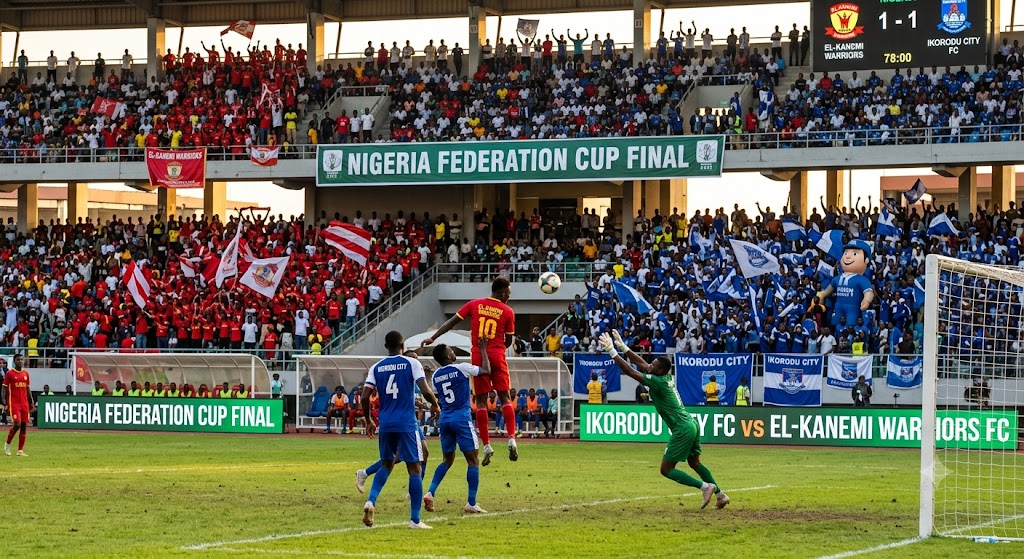
I hear there was a football match over the weekend between El-Kanemi Warriors and Ikorodu City. Someone told me it was the Nigerian Federation Cup final.
I refused to believe them.
How could it be?
The FIFA World Cup is on. The whole football world is focused on the biggest sporting event on earth. We were busy watching the quarter-finals, discussing tactics, arguing over refereeing decisions and predicting who would lift the trophy.
Then, all of a sudden, two teams played somewhere in Nigeria and we were told it was our own domestic cup final.
How?
When did our biggest domestic cup competition become something that could be quietly squeezed into the middle of a World Cup, almost as though it was an afterthought?
Another own goal from the Nigeria Football Federation
The leadership of the Nigeria Football Federation has once again failed to showcase what should be one of the country’s biggest football spectacles.
This is the Federation’s flagship competition.
This is the tournament that should produce giant killings, fairy tales, unforgettable finals and lifelong memories.
Instead, it passed almost unnoticed.
Ironically, if Nigeria had qualified for this World Cup, the NFF leadership would probably have been in the United States, Canada or Mexico, following the Super Eagles.
But Nigeria failed to qualify.
They were here, yet, they still could not give Nigerians a Federation Cup final worthy of the occasion.
How does that happen? Why do we keep getting the basics wrong?
Why can’t we plan properly? Why can’t we attract sponsors?
Why can’t we market our competitions? Why can’t we make Nigerians look forward to our football again?
There are too many questions, and too few answers.
I remember 1984.
That was the first Challenge Cup I truly followed.
Back then, the whole country, at least everyone who loved football looked forward to the competition.
State champions qualified for the national competition before teams were grouped into zonal round-robin stages. From there came the quarter-finals, and then straight knockout football.
Every match mattered. Every upset became national news. Every week gave us something to talk about.
Then there was Leventis United. They were a club from Ibadan playing in the old Third Division.
On paper, they had no business winning the Challenge Cup.
Not when the country had giants like Rangers International, the reigning league champions.
Not when NNB FC had just won the WAFU Cup, and not when there was the mighty Abiola Babes, bankrolled by the late Chief M.K.O. Abiola.
Yet football has never been played on paper.
Leventis United had a wonderful team: Edward Ansah, John Benson, Leotis Boateng, Bunmi Adigun, Wole Odegbami, Uwem Ekarika, James Etokebe, Matthew Onyeama and several others.
In the quarter-finals, they defeated league champions Rangers 1-0, thanks to a goal by Bunmi Adigun.
In the semi-finals, they eliminated NNB FC 2-1, and then came the final against Abiola Babes.
Again, Bunmi Adigun scored, and again, Leventis United won 1-0.
A Third Division club had beaten three First Division heavyweights to lift Nigeria’s biggest cup competition.
That was the magic of the Challenge Cup.
There were stories; there were heroes, and there were myths.
One of the popular stories back then was that once Bunmi Adigun scored for Leventis United, the match was over.
Whether it was true or not didn’t matter.
That was football, and that was the beauty of the competition.
People talked about it in buses, offices, schools and beer parlours.
A year later, Abiola Babes won the cup, and in 1986, Leventis won it again.
Then came the unforgettable 1987 final between Abiola Babes and Ranchers Bees, where referee Linus Mbah reportedly disallowed nine goals in one match.
Can you imagine the arguments that followed?
Then, in 1989, a relatively unknown coach named Shaibu Amodu announced himself to the country by leading BCC Lions to victory over Iwuanyanwu Nationale in the final, with Aham Nwankwo scoring the Cup winning goal.
Every season produced another story, another hero, and gave Nigerian football another chapter worth remembering.
But I wonder what stories we are telling today, and how many Nigerians even knew the Federation Cup final was taking place?
How many knew the finalists? How many knew the venue?
How many children watched it and dreamed of one day lifting that trophy?
That is the real tragedy.
The problem isn’t that El-Kanemi Warriors won.
Congratulations to them.
The problem is that the competition itself no longer carries the prestige it once did.
A country’s oldest cup competition should never feel like an obligation that administrators are simply trying to get out of the way.
It should be an event, an event that should be celebrated.
It should dominate conversations.
It should have weeks of build-up, television programmes, documentaries, newspaper features and community excitement.
That is how you build football culture.
That is how you create traditions.
That is how trophies become legendary.
Dear Ibrahim Gusau and the leadership of the Nigeria Football Federation, Nigerian football is bigger than the Super Eagles.
Our football ecosystem includes clubs, grassroots competitions, academies, women’s football and domestic cup competitions that have shaped generations of players and supporters.
The Federation Cup deserves respect.
It deserves planning, proper marketing, and most importantly, it deserves a final that Nigerians know is taking place before the final whistle has already gone.
Congratulations once again to El-Kanemi Warriors.
I sincerely hope they represent Nigeria proudly on the continent next season.
But I also hope that next year’s Federation Cup final is treated like the major national football event it is supposed to be.
Because if we continue to diminish our own competitions, we shouldn’t be surprised when Nigerians stop paying attention to them.
My seven minutes are up.

